VTAC Year 12 Guide
Getting started
What is a "mature-age" applicant?
‘Mature-age’ can have different definitions across tertiary institutions. This is because some institutions have mature-age entry programs where your age and experience are considered as part of your application. However, many people use 'mature-age' as a general term to refer to adults who return to study.
Regardless of whether you fit each ‘mature-age’ definition, the application process is similar. This page provides an overview of key information and directs you to more detailed information.
From Monday 3 August 2026 you will be able to submit your application for tertiary courses starting in 2027. The deadline for timely applications is 5pm, Monday 28 September 2026. Equity schemes (SEAS) and scholarship applications close on 9 October 2026 (5pm). Find all deadlines on our important dates page.
The VTAC Guide for Mature-age Applicants is designed to lead you through the process of researching tertiary education and applying for courses, special consideration (SEAS) and scholarships.
VTAC’s role
The Victorian Tertiary Admissions Centre (VTAC) is a hub for tertiary course applications in Victoria. VTAC receives, processes and forwards applications to the institutions you have applied to. We don’t decide who gets into a course—that’s the institutions’ job. We just make the process a lot easier for you and them. We also process special consideration claims through the SEAS application and some scholarship applications.
Which courses use VTAC?
Applications to some vocational education and training (VET) courses, undergraduate higher education courses and graduate-entry courses are administered through VTAC. However, most post-graduate courses require applicants apply directly to the institution. Use CourseSearch to search for courses that require you to apply through VTAC.
Why study?
When you closed your last book in high school you might have thought, ‘well, that’s it for me’. So why would you want to go back now?
For work:
- Update your knowledge
- Gain new skills
- Improve existing skills
- Get qualified
- Upgrade your qualifications
- Get a pay rise
- Get promoted
- Find more satisfying work
- Start a whole new career.
For pleasure:
- Spend time doing something you love
- Explore a subject area that has always fascinated you
- Meet new people
- Interact with others who have similar interests as you.
For growth:
- Learn something new
- Use the skills you already have
- Stretch your abilities
- Add a new dimension to your life
- Boost your self-confidence
- Challenge yourself
- Enrich your life.
Finding the time
Work, family responsibilities and other commitments may leave you with very little time to attend classes or study. However there are some options available to you if you decide you want to return to study.
Studying part-time
Many courses have a part-time option so you don’t have to drop everything you are doing to return to study. This option lets you take fewer subjects and spend less time each week on your course so you still have time for other aspects of life. To see if part-time options are available for courses in VTAC CourseSearch look for the ‘PT’ (part time) indicator near the course name.
Studying evenings
Many institutions run classes in the evening. This option is handy if you need your days free for work or other responsibilities.
Studying weekends
Some institutions offer courses at the weekend. This is a great option if you are busy from Monday to Friday but have some free time on weekends.
Working less
If you can reduce the hours you spend at work, you’ll have more time for classes and study. Some employers will give you study leave, especially if the course is related to your work.
Asking for help
The support of family and friends is priceless when you want to pursue something new. Sometimes it’s as simple as asking your family to pitch in for a few hours every week. A bit of help with dinner, shopping or other things you usually take care of might give you a couple of nights free to study.
Childcare
Maybe you need someone to watch your children for a few hours while you attend class. You may already have this kind of support from family and friends. If not, most tertiary institutions offer childcare on a fee-paying basis or sometimes on the basis of a commitment of your time. Check with institutions about study options and childcare services.
Researching tertiary education
Choosing a course
To help you decide which course is right for you we suggest that you:
Research careers
- Talk to people about careers in their industry/sector
- Search for career information online
- Browse though career resources at your local library
Research institutions
- Attend open days to see the campus and facilities
- Browse institution websites
- Read guides about institutions
- Talk to friends, family and workmates about the institutions where they studied.
Research courses
- Use CourseSearch and search institution websites for course information
- Browse through courses guides, course brochures and handbooks
- Attend course information sessions
- Talk to course representatives online, by phone or at open days
- Talk to friends, family and workmates who have done the course.
Create a shortlist
- Use the CourseSearch shortlist function: add all the courses that interest you by clicking on the star
- Check if you meet the entrance requirements for the institution
- Check if there are any prerequisite studies or skills you must have before you can do the course
- If you have any questions about whether you are eligible for the course, contact the institution for advice.
Evaluate your options
- Consider which course best matches your interests
- Consider your practical needs
- Discuss your options with your family and friends
- Think about which qualification best suits your employment ambitions
- Talk to employers and others who work in the industry.
Think about
The variety of courses available
If you think all courses are the same, think again. It’s true you will need some skills in reading and writing for tertiary study, but if this is not your strength or you prefer something different, there are lots of courses where you can use your practical, physical and creative skills. You can even find courses that don’t have exams. Browse through course guides or institution websites to see the wide range of courses available.
Where to start
You can start your studies at different levels. It may be appropriate to begin with a few short courses or a diploma to get back into the swing of it, instead of jumping straight into a degree course.
Finding out what it’s really like
Although you can get a broad idea of what the course is about from course guides and websites, the best way to get a true understanding of what is involved is to talk to people. Go to information sessions and open days and ask questions to the people who run the course.
How to use CourseSearch
CourseSearch lists over 1,600 courses offered through VTAC. It's a powerful search tool and contains essential information needed during the course application process. This includes the essential requirements and admission criteria, including prerequisite studies, required for entry into each course.
Use CourseSearch to discover courses
Keyword search
When you go to CourseSearch the first thing you'll see is a text box to search for keywords. You can type more than one search term, separated by a space, and CourseSearch will look for courses with these terms in the course title, groups and qualification level fields, name of the institution and campus. So, searching for “economics Melbourne” will bring up results where the words “economics” and “Melbourne” are found in these fields.
You can also look for parts of words, so searching for “psych” will pick up courses which mention psychology, psychiatry, psychological, and so on.
Search by major
Some courses have broad subject offerings, such as a Bachelor of Science or Bachelor of Arts. To search disciplines you can take as a major (an area of specialisation)—such as biology, media studies or politics—select the “Include majors in keyword search” tick box.
Advanced Search
The Advanced Search options—available once you submit a search—allow you to modify your search in several ways. You will find these on the left side of your screen, or above the search results if using a mobile device.
You can refine your search results by institution, campus and qualification level. You should use these filters if you are getting a large number of results that you want to narrow down, or if you have a particular institution or campus in mind.
If you want to browse a broad range of related courses, you can use the “Area of Interest” drop-down menu.
You can also filter by whether you apply for the course through VTAC, or directly to the institution—by default, CourseSearch will show you both application methods.
Shortlist
If you've gone through the list of courses and find a course you are interested in, you can add it to a shortlist by clicking on the “star” button in the top right corner of the course entry. This saves the course temporarily in your browser. To view your shortlist, and to remove courses from it, click on “View Shortlist”. Once you close your browser, your list will be deleted. If you want to hang on to the list, you can email it to yourself by typing your email address above the list and hitting “Send”.
Reading a course entry
This diagram explains all the sections of a course entry. You can also download it as a PDF.
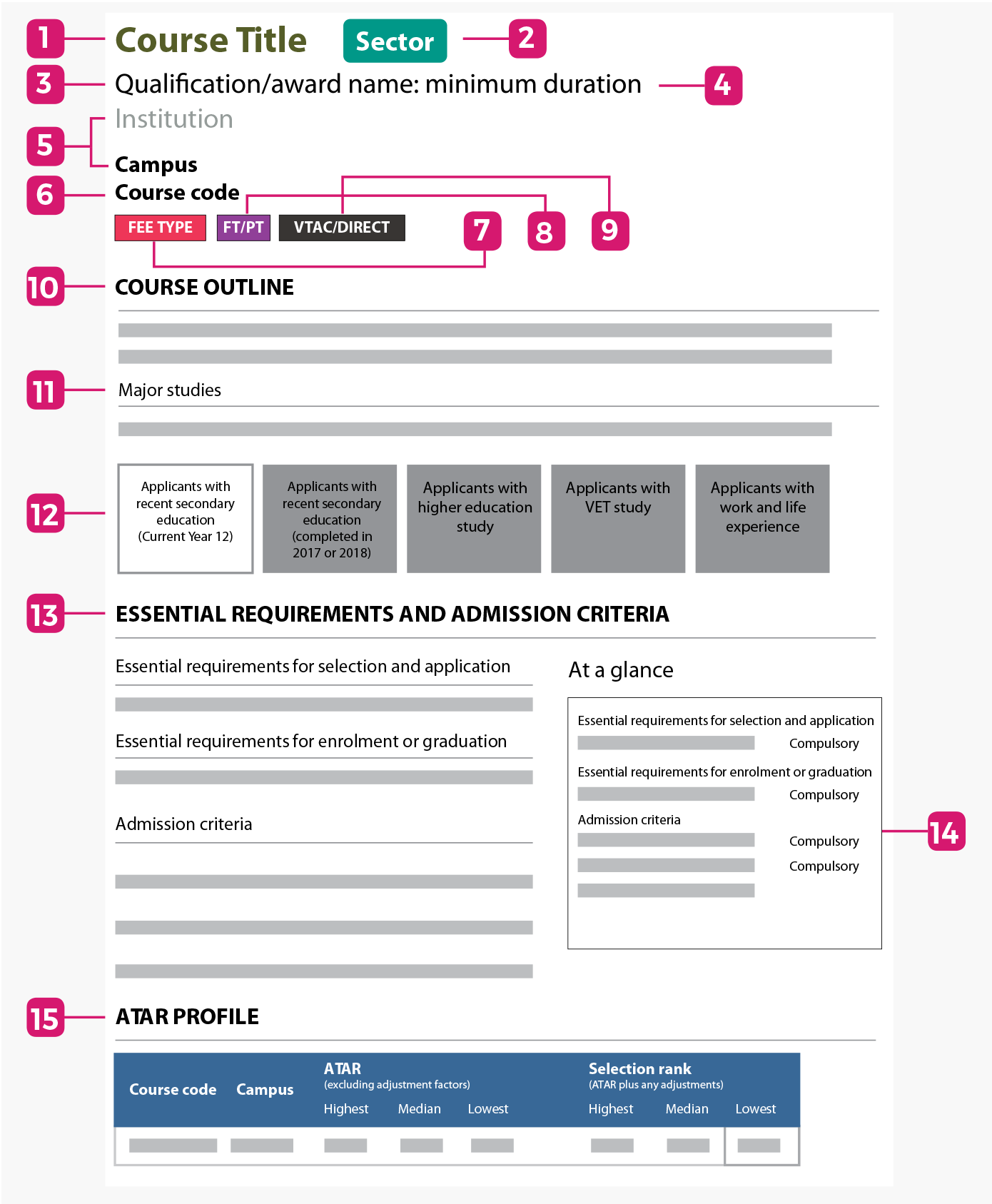
1 Course title
The course title tells you the area of study.
2 Sector
This tells you at what level the qualification is: vocational education and training, higher education, or higher education graduate-entry (for people who already have a Bachelor’s degree).
3 Qualification/award name
The qualification/award name is the formal title of the course including the level of study (e.g. Certificate, Advanced Diploma, Bachelor’s degree). However, it is really important to look beyond the title when researching a course, to ensure it meets your expectations.
4 Minimum duration
The minimum duration is the shortest time in which you can complete the course. Often this is as a full-time student. For parttime students it will typically take longer.
5 Institution and campus
This tells you which institution the course is offered by and, importantly, which of their campuses it is offered at. Some institutions have campuses all around Victoria, so as a part of your research, make sure you’re able to get to/move to the campus.
6 Course code
This is important to note when you put in your application.
7 Fee type
Fee types tell you if the course is government subsidised or if you are liable to pay for the entire course. Fee amounts can vary dramatically so this is a big thing to consider as a part of your research.
8 Mode
FT tells you the course is offered on a full-time basis. PT tells you the course is offered on a part-time basis. Some courses will be restricted to one mode or the other.
9 Application method
Most courses in CourseSearch require an application through VTAC, but some require you to apply directly to the institution.
10 Course outline
The course outline gives you a summary of the course, and subsections may include career opportunities and pathway options. However, this is just an overview—to thoroughly research the course visit the institution’s webpage and visit the campus to learn about the course structure and subject offerings.
11 Major studies
Major studies are the areas you can specialise in. Note that courses with the same name may offer different major studies.
12 Select your applicant group
A course may have different essential requirements and admission criteria for applicants depending on your educational history and work/ life experience. See Select your category below.
13 Essential requirements and admission criteria
This is where you will find prerequisites and other requirements and criteria you must meet to be eligible for selection into a course. Essential requirements are criteria for a course that are compulsory for all applicants. Essential requirements for selection and application must be completed to be considered for entry. Essential requirements for enrolment or graduation are advisory: they are not required for selection, but the course requires them for enrolment or completion of the course. Admission criteria may only apply to certain types of applicant, or may not be compulsory.
14 At a glance
The ‘At a glance’ table summarises the essential requirements and admission criteria for the applicant group you have chosen, and also tells you which ones are compulsory.
15 ATAR profile
Courses that use the ATAR in selection publish an ATAR profile.
Find course requirements and prerequisite studies
Course requirements, including prerequisite studies, are listed under each course entry in CourseSearch. They can be found under the headings ‘Essential requirements' and ‘Admission criteria'.
Select your category
Course requirements are listed by applicant category. Your applicant category is based on the highest level of education you have undertaken. If it is year 12, how recently you completed determines the category. This questionnaire will help you identify your applicant category.
Note that ‘mature-age’ is not an applicant category, rather it is term that applies to the Special Entry Access Scheme (SEAS) Category 1 or can be used more generally to refer to adults returning to study. If you have not completed year 12 or completed it several years ago and did not go on to university, TAFE or a tertiary college, you should select "applicants with work and life experience".
Essential requirements
Essential requirements need to be completed either before applying, before enrolling or during the course. For example, you may be required to complete a first aid certificate before enrolling or a police check before a work placement.
Admission criteria
Admission criteria details what will be considered when selecting applicants for entry into a course.

Course codes and fee types
Every course that accepts applications through VTAC has a VTAC course code. Some have more than one. These codes are extremely important when applying for courses because the course code is specific to each course, institution, and campus. You find them in course entries on CourseSearch and you will use them when you apply and complete your course preference list.
What are the fee types?
The last digit of the course code (1, 2, 3 or 4) shows you the type of course fees you will be required to pay if you get an offer:
- Codes that end in 1 are government-supported university places, so you only pay part of the cost
- Codes that end in 2 are domestic full-fee places, so you pay the full cost
- Codes that end in 3 are international full-fee places, so you pay the full cost
- Codes that end in 4 are VET courses. You may have to pay full fees or you may be eligible for a government-funded place. If you are finishing year 12, you will usually be eligible for a government-funded place. Contact the institution for more information
Why do some courses have no course codes?
If the course information does not include any VTAC course codes, it means they accept applications directly to the institution (not through VTAC).
Download
- How to use CourseSearch fact sheet
Applying in 2026
This following section covers each step of the application and offer process. You can also find this information in the print friendly guides and fact sheets available on our factsheets page.
From 3 August 2026 until 5pm, 28 September 2026, you can submit a timely application for courses commencing in 2027. Applications are accepted online, through the VTAC website.
Eligibility
To apply through VTAC, you must meet citizenship and residency requirements.
The types of courses you can apply for depends upon your previous study, check minimum tertiary entrance requirements. If you don’t meet minimum tertiary entrance requirements, you may find some mature-age entry programs will set alternative entrance requirements (see next section).
Another option for planning a return to study, is to plan a pathway from a course you are eligible for to the one you wish to study. This includes programs that help you prepare for tertiary study or provide alternative pathways to the course you want.
Research mature-age entry programs
Mature-age entry programs are designed to assist those who have been away from study enter tertiary education.
The age requirements and policies for mature-age entry differ across institutions. To check the mature-age policies of the institutions you are applying to, and to check if there are additional requirements you need to complete, visit the institutions' pages.
Some institutions provide consideration for mature-age entry as part of VTAC’s Special Entry Access Scheme (SEAS). To find the institutions that use this program, see SEAS: Personal information and location. If you are applying for institutions that use this program, you will be automatically considered - no need to opt-in or provide additional evidence. This can only benefit your application, but if you do not wish to be considered, you may opt-out in the 'Permissions' area of your VTAC account.
Deadlines and fees
The cost of the application processing fee depends on when you submit your application.
There are no additional fees for submitting an Equity schemes (SEAS) or scholarships application or for changing your preferences.
Timely applications
Fee $104 for post-school applicantsApplication deadline 28 September 2026 (5pm)
Late applications
Fee $166
Deadline 30 October 2026 (5pm)
Very late applications
Fee $208
Deadline 4 December 2026 (5pm)
Post main-round applications
Applications for a limited range of courses will be accepted after the main round of selection has been completed. For more information check the VTAC website in early January 2027.
Refund policy
VTAC does not issue refunds on course application processing fees, except as required by law. You remain liable for the fee even if you withdraw your course application.
Understand your VTAC journey

1 Research courses
Use CourseSearch to browse through over 1,600 courses to help you find those that suit you best. Make sure you check prerequisites and other essential requirements and admission criteria. There are also over 500 courses with no ATAR requirement for students graduating without an ATAR or those looking for a pathway to their dream course.
2 Learn the application process
Read up on the process: who can apply, eligibility requirements, special consideration, scholarships and the steps to apply.
3 Create your profile
Ready to apply? You'll need to create an account on the VTAC website and provide some personal and education details. Once you've done that you can use the same account to apply for courses, and Euity schemes (SEAS) and scholarships.
4 Apply for courses
You can apply for up to eight courses by listing them in preference order. Don't worry if you change your mind—you can change them throughout the application period.
5 Apply for Equity schemes (SEAS) and scholarships
If your education has been affected by circumstances outside your control, you can apply for special consideration through SEAS. There are lots of different scholarships and they are not all for academic achievement. You might be eligible for more than you think.
6 Complete the essential requirements and admission criteria
Each course has its own essential requirements and admission criteria. Make sure you meet these for each course you apply to and complete any tasks listed.
7 Make final changes
Log in to your VTAC account to change your preferences or update your personal information.
8 Find out about offers
Offers are sent to your email and released via your VTAC account on specific dates (known as offer rounds).
Applying interstate and overseas
If you are applying interstate you will need to apply through the relevant tertiary admissions centre—there is one in most states and your ATAR is treated the same way across Australia. Visit Course Seeker for a list of courses available across Australia.
- ACT/NSW: Universities Admissions Centre (UAC)
- NT: To apply for undergraduate and postgraduate courses at Charles Darwin University, you must apply through South Australian Tertiary Admissions Centre (SATAC)
- QLD: Queensland Tertiary Admissions Centre (QTAC)
- SA: South Australian Tertiary Admissions Centre (SATAC)
- TAS: University of Tasmania
- WA: Tertiary Institutions Service Centre (TISC)

Taking a gap year
If you're thinking of taking a gap year, you might want to consider applying for a course and deferring your start for a year. That way you've already got a place and you can apply for a different course the following year should you change your mind. Read the deferment policies for the courses you're interested in.
Download
Create your VTAC account
You need to create a VTAC account to apply for courses, the special entry access scheme (SEAS) and scholarships.
What you will need
To register for a VTAC account, you will need to provide:
- your full name, date of birth and contact details
- any previous names you have used
- your visa details (if you are not an Australian or New Zealand citizen),
- your passport number (if you are not an Australian citizen, New Zealand citizen or don't hold an Australian permanent residency visa), and
- a Unique Student Identifier (USI), which you can create at usi.gov.au
Read VTAC's privacy policy, to understand who can access your information.

How to create your VTAC account
See our Completing your profile page for step-by-step instructions.
Tips for creating your VTAC account and completing your profile
Other names
Provide your name and any other names you've used. This is so we can find any previous results, and we can ensure all your applications for courses, SEAS and scholarships are linked to you.
Citizenship and residency details
Australian citizens and permanent residents can apply through VTAC, however most people on temporary visas will need to apply directly to tertiary institutions.
Details of studies:
You need to declare any previous studies you have undertaken, including incomplete courses. If you completed or attempted a senior secondary qualification (e.g. VCE, HSC, NCEA, IB, High School Diploma), and any post-secondary study you've done, like a university or TAFE course, enter the details when prompted.
VTAC can access most Australian year 12 and Australian university results electronically, so you may not need to provide any documents. Keep an eye out for any prompts or emails which request that you upload transcripts.
Account security: Multi-factor authentication
You will need to have access to a mobile number, where an authentication code will be sent to the mobile in order to verify your account.
Download
Apply for courses
Once you have created a VTAC account and completed your profile, you can start applying for courses.
What you will need
You list up to eight course preferences in your VTAC application. To complete your course application, you will need the details of courses you wish to apply for. On the preferences screen, you can seach for courses using our institution, qualification level, or key word filters.
How to apply for courses
See step-by-step instructions for applying for courses or download the How to apply for courses factsheet
factsheet.
Understand the preference system
If you want to get the best offer available to you, it is important to understand the preference system.
VTAC allows you to select a minimum of one and maximum of eight course preferences. You must list each course in order of preference, with the one you most want at the top of your list.
You can only receive one offer in each round and that will be the highest listed course you are selected for. This is why you must list your courses in order of preference.
How the offer system works
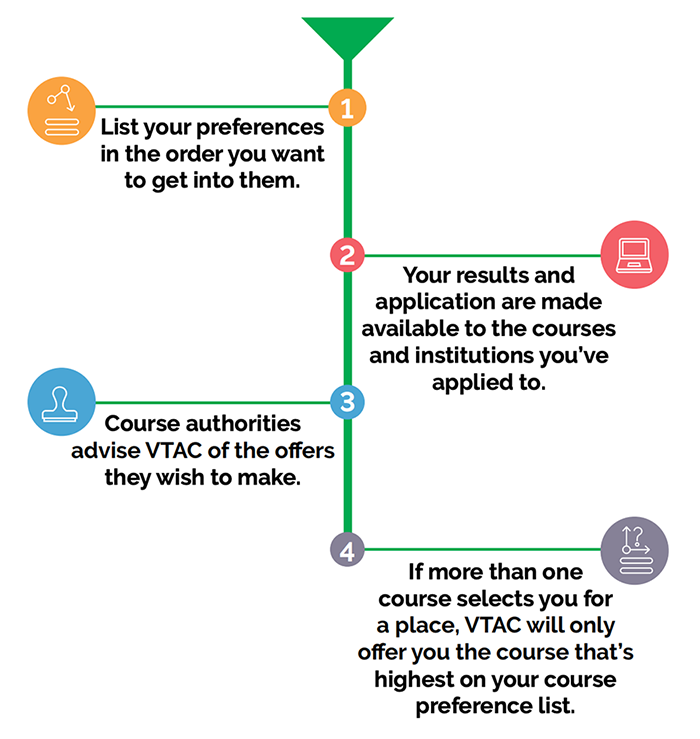
- List your preferences in the order you want to get into them.
- List your preferences in the order you want to get into them.
- Your results and application are made available to the courses and institutions you’ve applied to.
- Course authorities advise VTAC of the offers they wish to make.
- If more than one course selects you for a place, VTAC will only offer you the course that’s highest on your course preference list.
- You list your preferences in the order you want to get into them
- Your results and application are made available to the courses and institutions you've applied to.
- Courses authorities advise VTAC of the offers they want to make.
- If more than one course selects you for a place, VTAC will only offer you the course that's highest on your course preference list.
Example preference list
When you list your course preferences:
- Only list courses you meet the essential requirements and admission criteria for
- Only list courses you would be happy to study
- Always list the course you most want to do at the top, and
- Also include some ‘pathway courses' in your list.
| List your courses in the order you want to get into them. For example: | ||
|---|---|---|
| Preference 1 | 1234567881 | My dream course |
| Preference 2 | 1234567781 | My second best course |
| Preference 3 | 1234567681 | A ‘pathway course' with similar subjects to my dream course, which could give me credit if I transfer into my dream course at a later date (although I would be happy to complete it if that doesn't happen). |
| Preference 4 | 1234567891 | Another ‘pathway course' like preference 3 but with fewer opportunities to gain credit. |
| Preference 5 | 1234567651 | A course in a similar field to my first and second preference, but without credit options. |
| Preference 6 | 1234567641 | A course in a similar field to my first and second preference, but without credit options and traditionally less competitive than my higher preferences. |
| Preference 7 | 1234567541 | A course in a similar field to my first and second preference, but without credit options and traditionally less competitive than my higher preferences. |
| Preference 8 | 1234567341 | A broad course which provides me with a good foundation through which to apply for further study later on. |
The following scenarios could occur, with the preference list above:
Scenario 1: You receive an offer for your ideal course. Congratulations!
Scenario 2: You receive an offer for your second best course, and are still automatically eligible for a higher offer (your ideal course) if there are vacancies in later rounds.
Scenario 3: You receive an offer for a ‘pathway course'. You will still be eligible for an offer for your ideal course if there are vacancies in later rounds.
Course application FAQs
What if I can't decide between two courses?
If you can't decide between two courses then look for more information online, visit the campus and talk to staff and current students. Check out the elective subjects offered by each of the courses.
What if I change my mind?
If you change your mind, change your preferences. Change of preference is open from August until November, in December and, for emergencies, in between offer rounds until the end of February.
Will institutions ignore my application if I don't put them first?
Preference listings are only used by VTAC to determine which course you want the most. Course authorities don't make selection decisions based on where you've listed the course on your preference list. They want applicants who have listed them, will succeed, and want to do their courses.
Why can't I receive an offer from all my preferences?
You will only receive an offer for the highest course that wants to make you an offer. You won't find out about any lower preferences, because those places will have already been offered to someone else. This is why it is important to list your preferences in the order you most want to do the courses.
Download
Complete any course requirements
Selection into a course is the responsibility of each institution and is based on what is published in institutional requirements and course requirements for each course. Some courses will select some applicants based on their previous study. Others might use other selection tools—examples include the Special Tertiary Admissions Test (STAT) and the VTAC Personal Statement. Some courses will use a combination of selection tools.
Is my previous study relevant?
When you apply for courses, your entire academic record is provided to the institutions’ selection officers. If you completed Year 12, it includes these results. It also includes any vocational education and training (VET) or higher education study you have completed.
You can also learn more about providing evidence for your previous studies here.
If you have any questions about demonstrating your academic ability for entry into a course, and alternative pathways to entry, contact the institution.
Is my work and life experience relevant?
Work and life experience is considered for entry to some courses and for some applicants. This is usually communicated by a VTAC Personal Statement. To see if this is required, check ‘essential requirements and admission criteria’ in the course entry within CourseSearch.
If you have previous study, work or life experience related to the course, your experience may count toward your qualification. Institutions have their own policies regarding previous study and experience. For more information see Credit transfer and recognition of prior learning (RPL).
Apply for equity schemes (SEAS) and scholarships
What is SEAS?
The Special Entry Access Scheme (SEAS) is designed to make sure institutions get a sense of your full potential if you have experienced difficulty during your education. It enables institutions to consider these circumstances and their impact when ranking eligible applicants for a course before making offers. SEAS also addresses the under-representation of certain demographics in some courses.
What SEAS is not
SEAS does not change your educational results or qualifications. And if you are granted special consideration it does not guarantee you an offer. If you apply for SEAS, you still need to meet the ‘essential requirements' and ‘admission criteria' for a course, including prerequisite studies.
Equity schemes (SEAS) and scholarships categories
There are four categories in equity schemes (SEAS) and scholarships. You can apply for all the categories that are relevant to your situation, so long as you apply to each category for a different reason.
- Personal information and location
- Disadvantaged financial background
- Disability or medical condition
- Difficult circumstances

How to apply for Equity schemes
You can apply for Equity schemes through your VTAC account, after you have lodged a course application. Equity schemes applications open on 3 August 2026 and close 5pm 9 October 2026.
Follow these step-by-step instructions to apply.
Providing evidence
Most Equity schemes & scholarships categories require you to provide evidence, and if you don't supply it your application will not be considered. Quality, not quantity, is the key to providing good and useful evidence. Evidence required may include:
- a written statement that you complete,
- a statement of support from a ‘responsible person' who has specific knowledge of your circumstances, and/or
- financial documentation.
Find out what evidence you need to supply and start preparing it well before the deadline.
Other special consideration schemes
Not all institutions use SEAS, and different institutions recognise different categories. Also, some institutions offer special consideration outside of SEAS. Find out which institutions participate in SEAS and which offer other special consideration programs.
Apply for scholarships
Scholarships help with the cost of study and are awarded for many different reasons, which include community involvement, academic achievement and where you live.
While the value of each scholarship varies, they can help you pay for books, study materials, moving expenses, course fees or other costs associated with tertiary study.
There are lots of scholarships you can apply for through VTAC. Others require you to apply to tertiary institutions or the organisation sponsoring them. It's worth spending an afternoon online, searching for scholarship opportunities. For example, a local community group might offer one that's ideal for you.
Scholarships through VTAC
The scholarships VTAC takes applications for are generally awarded under three categories:
Access and equity scholarships are most often awarded by institutions to support equitable access to tertiary education. Criteria include financial disadvantage, relocating from regional and rural areas or being part of an access equity group.
Merit scholarships are awarded for academic achievement.
Indigenous Commonwealth scholarships are awarded to Aboriginal or Torres Strait Islander applicants across a variety of categories.
What are my chances?
Your chances firstly depend on whether you apply or not. Then it depends on how many scholarships in a category are available, your eligibility and how you are assessed compared to other eligible applicants. For example, some scholarships are based on an income assessment – if you meet the criteria, you will get a scholarship. For other scholarships, chances vary more widely. Many of the scholarships through VTAC are based on equity and access, leadership abilities and community experience, so don't be deterred if you're not a 'straight A' student.
How to apply for scholarships
You apply for scholarships through your VTAC account. It's simply a matter of following the prompts and entering any relevant details. Most questions require concise written responses. These have strict character limits so it can be a good idea to write a draft first.
Scholarship applications open on 3 August 2026. The scholarship application – and all supporting evidence – must be submitted by 5pm 9 October 2026.
Follow these step-by-step instructions to apply.
Providing evidence
Most scholarships require you to provide evidence, and if you don't supply it your application will not be considered. Quality, not quantity, is the key to providing good and useful evidence.
Evidence required may include:
- a written statement that you complete
- a statement of support from a ‘responsible person' who has specific knowledge of your circumstances, and/or
- financial documentation.
Find out what evidence you need to supply and start preparing it well before the deadline.
An equity schemes (SEAS) application is (almost) the same as the scholarship application
Which is why every person that wants to submitting an equity schemes (SEAS) application should complete the scholarship section of the application. You can even use the same supporting evidence.
Download
Change of preference
If you change your mind about the course you want to study you can change your course preferences.
What is change of preference?
During specified periods you can add, remove or re-order the course preferences in your VTAC course application.
You may want to change your preferences if you have changed your mind about which course you most want to study, if a new course has become available and you would like to add it to your preference list, or if a course you had applied for has been cancelled and you want to replace it on your preferences list.
There is no cost involved in changing your preferences. As long as you have paid your course application processing fee, you can change your preferences as many times as you like within the specified periods.

When can I change my preference?
Straight away
Once you've applied, you can keep doing this as many times as you like, free of charge, until the closing date.
After offers come out
You can also change your preferences between offer rounds, but some courses may already have filled all their places.
All change of preference dates are listed under important dates.
How to change your course preferences
To change your course preferences, log in to your VTAC account and follow the prompts. You can add, delete or re-order your preferences using the up and down arrows.
Some courses do not accept new course applications after a certain date, so check the course description and selection criteria carefully for any new courses you want to add.
You will also need to make sure you meet the requirements for any new courses you add. If you have missed a selection requirement deadline contact the institution to see if you can still apply.
For step-by-step instructions see changing your course preferences.
Offers and enrolment
When are offers released?
November Round
Some courses will make offers in the November round to some applicants. Not all courses make offers in this round, and all courses make further offers in January, so don't panic if you don't receive an offer in this round. These offers will be released on 24 November 2026.
January Round
There are multiple offer rounds, but the main round that all courses participate in—and through which most offers are made—is January Round. This round of offers will be released on 12 January 2027.
Subsequent rounds
After the January Round, there are multiple subsequent rounds. Course authorities can only make offers in future rounds if there are places available—some courses may fill their quotas in the first round. Your chances of receiving an offer in each round will vary for each course. Typically, there are fewer offers made in each subsequent round.
Supplementary offers
Some institutions make supplementary offers after January Round 2 if they have places available. A supplementary offer is for a course that you have not listed on your course preferences.
You may receive supplementary offers if you have:
- not received an offer listed on your course preferences, and
- given VTAC permission to release your application to all courses with vacancies.
You give this permission either at the time of applying, or you can do this later in your VTAC account. Supplementary offers will be processed weekly after January Round 2.
For all dates for all offer rounds, see VTAC's important dates.
How are offers released?
Offer notifications are sent by email throughout the morning and early afternoon until 2 pm.
Because of the volume of offers going out on that day, VTAC will stagger the email roll out, so don't be concerned if it's 12 noon and you haven't received an email but your friend has.
At 2pm, you will be able to log into your VTAC account and view your offer in the ‘Course offers' section.
Your offer email is a notification that an offer has been made. The institution will contact you separately with instructions and deadlines for enrolling—usually within two business days. If you do not receive these instructions, you need to contact the institution and not VTAC.
All offers are provisional. Any offer you receive is subject to you:
- Meeting eligibility requirements,
- Having provided full and correct information on your VTAC application, and
- Attending enrolment at the time and date specified in your offer message.
If you don't meet these requirements, your offer may lapse or be withdrawn.
Accept an offer by enrolling
To accept an offer you must enrol in the course.
Enrolment procedures will be outlined in the offer email sent by the institution. These instructions differ across each institution. In some cases you may be required to attend in person at a specific date and time, others might require you to enrol online.
If you are unable to enrol as instructed, you should check with the institution about what other arrangements are available. Don't leave this too late, as you may be required to organise documentation and someone to act on your behalf.
Remember, you must enrol by the deadline set by the institution—make sure that you don't miss out.
Hoping for a better offer in a future round?
VTAC recommends that you accept any offer you receive, as that offer will usually lapse before the release of the next round's offers. By accepting your earlier offer, you will at least have that course to fall back on if no further offers are made. Accepting an offer does not prevent you from being considered for higher preferences in later offer rounds.
Have mixed feelings about the course or interested in something else?
You can accept your offer and still be eligible for offers from higher preferences in future rounds. Just make sure that whichever course you're hoping to get an offer from is listed higher on your preference list than what you've already been offered. For example, if you received an offer from your third preference, you'll automatically be considered for offers from preferences one and two — but you could also change your preferences and add other courses above the offered course.
If there is a course lower on your preference list or new course you are interested in, you can make use of change of preference between the offer rounds. If you move the course you received an offer for down your list, you will be considered for anything above that course in future offer rounds. Then, should you receive a better offer, you can accept that and withdraw from the previous course.
No longer interested in the course you've been offered?
Accepting an offer for a course is your choice. If you have absolutely no desire to enrol in that course, then simply ignore the offer. The offer will lapse and the place will go to somebody else. Just be sure about any decision to not accept a course offer—offers cannot be accepted once they have lapsed.
Didn't get an offer?
If you didn't receive an offer in the January Round, you might still receive an offer in February Round 1. However, it's important to know most offers are made in the January Round. So while you might wait in hope for a later round offer it's also a good idea to do some strategic research.
You can change your preferences between rounds so contact institutions for assistance identifying pathway courses or other courses you might want to add to your preference list before change of preference closes.
Also make sure you give permission for institutions to give you supplementary offers.