VTAC Year 12 Guide
Getting started
While you are in year 12 you will need to start planning for life after school. If you want to go on to tertiary education, you also need to research and apply for courses.
From Monday 3 August 2026 you will be able to submit your application for tertiary courses starting in 2027. The deadline for timely applications is 5pm, Monday 28 September 2026. Equity schemes (SEAS) and scholarship applications close on 9 October 2026 (5pm). Find all deadlines on our important dates page.
The VTAC Year 12 Guide is designed to lead you through the process of researching tertiary education and applying for courses, special consideration (SEAS) and scholarships.
You can also download the VTAC Quick Reference Guide for Year 12 Students or a postcard with key dates.
Put together your plan
You need to apply for tertiary courses by the end of September to take advantage of the lower application fee, so it's important you don't leave your course research to the last minute. Here are some tips for planning your time so you can research courses properly.
Get organised
Being organised is a set of skills you learn. It comes easily to some, but many of us have to put our mind to it and make an effort to learn strategies and techniques. Mostly, being organised rests on the following five steps:
- Listing everything you need to do,
- Identifying priorities,
- Allocating time to different tasks,
- Writing a plan, and
- Keeping track of progress and reviewing your plan.
List everything you need to do
In year 12 you have a lot of competing priorities: committing the right amount of time to each of your studies and assessment tasks, exercising, eating properly, de-stressing with leisure time and sleeping well. You may have a job too. On top of all that, you need to commit some time to researching what you want to do after school. Write all these down.
Identify priorities
Circle your top priorities for the year, and identify which parts of your life might have to go on hold during your senior school years. Your priorities might also change at different times of the year, so make a note of this.

Allocate time
The amount of time it takes to research courses depends on the individual. It might be a straightforward or complicated process. Keep in mind you need to research more than one course as there are eight course preferences you can use.
You need to make time for:
- Reflecting on your interests and strengths
- Online research
- Visiting tertiary institutions – (open days are often in August)
- Talking through the courses and/or careers you're considering with allies or people who know about the course and/or associated careers
- Decision making
- Applying to courses
- Researching and applying for scholarships, and if it's relevant to your circumstances,
- Applying for special consideration (SEAS), which includes organising supporting evidence.
The worst time to research courses is when you're facing immediate deadlines—so start early.
Reflect upon your interests and strengths
You are likely to have been asked to identify your interests and strengths in year 10 and 11. These can change over time. Use this worksheet to revisit and reflect upon your strengths, interests and preferred course criteria.
Write a plan
Here are some basics for writing a plan.
- Get a planner—a diary, wall chart or online calendar.
- Mark in your school holidays, when assessments are due, and opportunities to visit institutions such as open day.
- Add the VTAC dates that apply to you.
- Think about how much time you will need to complete your assessment tasks and mark out that time before the due dates.
- Add an extra week or two to the time you just marked out for assessments, to give yourself extra time to account for unforeseen changes.
- Mark in other regular and/or important events, such as sports training, family commitments, and time you'll be away from home.
- Now look for the parts of your planner that are least cluttered—these could be the best times to work on your course research.
- Block out time in your planner for course research and applying for courses.
Tips
- Make a folder on your computer, use an online bookmark tool, or keep a notebook for course research.
- Online research can be done in short bursts but remember to make a note of what you've discovered so you can compare courses later.
- Keep track of things and review your plan
- The most important part of planning is to follow your plan and, when it needs changing, change it. Keep your plan up-to-date and review your priorities regularly.
- You might also like to include a list of things to achieve so you can check them off as they are completed—this can remind you that you are making progress.
Do your best and look after yourself
No one expects you to have it all worked out—and many people are still searching for a preferred course or career well into adult life. If you make time to reflect on these things regularly it can make decision-making easier later on.
If you are feeling stressed out, make sure you talk through what's going on with one of your allies or a school counsellor. Kids Helpline (1800 55 1800), and Youth Beyond Blue (1300 22 4636) also provide free telephone counselling.
Download
Finding courses
If you haven't already started to research tertiary education, it's important to get onto this as soon as possible, as it takes time. Try to have most of your course research completed before September, and make sure you have visited the institutions you are most interested in.
Your course eligibility depends on what you study in year 12, and if you graduate with or without an ATAR.
| Graduating with an ATAR |
You can apply for bachelors' degrees, diplomas and certificates. Each will have certain prerequisities you'll be required to meet to be considered, as well as an ATAR profile that will indicate the competitiveness of the course. |
|---|---|
| Graduating without an ATAR | You can apply for some bachelors' degrees, some diplomas and certificates. Some degrees and diplomas do not require an ATAR or prerequisties so these courses are a good option if you do not have an ATAR. You can search for courses with no prerequisities in our VCE prerequisite explorer tool in CourseSearch. |
VTAC Tertiary Research Guide
We have put together the VTAC Tertiary Research Guide containing detailed information to support your research journey.
This guide covers:
- the benefits of tertiary education
- course research tools and resources
- questions you should ask
- researching careers and finding a 30 minute mentor
- understanding the types of tertiary course
- how to find eligibility and course requirements
- researching prerequisites and selection requirements
- preparing for interviews, auditions and folios
- planning pathways
- researching campus life
- researching the costs associated with tertiary education

How to use CourseSearch
CourseSearch lists over 1,600 courses offered through VTAC. It's a powerful search tool and contains essential information needed during the course application process. This includes the essential requirements and admission criteria, including prerequisite studies, required for entry into each course.
Use CourseSearch to discover courses
Keyword search
When you go to CourseSearch, the first thing you'll see is a text box to search for keywords and a list of filter options. You can start a search by typing in a keyword or more than one search term, separated by a space—CourseSearch will look for all of them.
As well as searching for your keyword in the course title, qualification level and major studies (area of specialisation) fields, CourseSearch will search the fields for the name of the institution and campus. So, searching for “commerce Melbourne” will bring up results where the words “commerce” and “Melbourne” are found in these fields
Filter courses
The 'filter courses' list of options can be used in conjunction with a keyword search to narrow down your search results. Alternatively, you can start a search using one or more filter without using the keyword search. You can refine your results by University, TAFE or College, estimated ATAR, qualification and others.
If you're a student in years 10-12 you can use the VCE prerequisite explorer tool to find courses you are eligible for based on your existing Unit 3 and 4 VCE study program (year 12 students) or a planned Unit 3 and 4 VCE study program (year 11 and 10 students). You can also use this tool to search for courses with no prerequisties.
If you are graduating without an ATAR, you might require a pathway to gain entry into a degree. There are over 500 courses listed on VTAC with no prerequisites that might be a suitable study option for you. You may want to look into certificates or diplomas that provide direct transfer or credit into your dream course. To find the right pathway, it would be best to speak to your dream institution to find out the best pathway to you course based on your study.
Create a course shortlist
If you've gone through a list of courses and find a course you are interested in, you can add it to your favourites by clicking on the 'heart' button next to the course name. This saves the course in your browser. To view, email or remove courses from your favourites list click on “View Favourites' found on the top right hand of the page.
Reading a course description
Course requirements
You can get detailed information on any course by clicking the course title in your search results. Requirements for the course are listed under various applicant categories.
Selecting your applicant category
A course may have different essential requirements and admission criteria for applicants depending on your educational history and work/ life experience. If you are studying and aiming to complete year 12 this year, choose the Studying year 12 category. If you are in year 11 or year 10 you can also select this category to see the prerequisite studies required for the year you intend to commence the course, and for an idea of requirements and criteria to expect. Be aware these requirements and criteria may change between years.
Essential requirements and admission criteria
This is where you will find prerequisites and other requirements and criteria you must meet to be eligible for selection into a course.
Essential requirements are criteria for a course that are compulsory for all applicants. Essential requirements for selection and application must be completed to be considered for selection into the course. Essential requirements for enrolment or graduation are advisory: they are not required for selection, but the course requires them for enrolment or completion of the course. These will need to be completed before enrolling or during the course. For example you may be required to complete a first aid certificate before enrolling or a police check before a work placement.
Compulsory requirements are criteria for a course that are compulsory for the certain applicants. For example, a prerequisite study may be compulsory for year 12 students but not for applicants that have started a bachelor degree.
Admission criteria details what will be considered when selecting applicants for entry into a course. These may only apply to certain types of applicant, or may not be compulsory. Read these requirements carefully to discover what may apply to you.
The 'Requirements checklist' summarises the essential requirements and other admission criteria for the applicant category you have chosen and also tells you which ones are compulsory.
ATAR and student profile
Courses that use the ATAR in selection publish an ATAR profile.
Decide on courses
Deciding on which courses to apply to is up to you. Other people might want to tell you what to choose, but ultimately you need to be happy with the decisions you make.
When you apply for courses you are given the opportunity to select eight courses to be considered for. You need to list them in order of preference, because you can only receive an offer for one course in each offer round. If you receive an offer, it will be for the highest preference that wishes to make you an offer.
This is why it is important to get your preference list in order. But how do you decide on what to put on your preference list?
Create your course criteria
Work out what you want in a course. Here are some example course criteria:
- I meet the prerequisites and other requirements (if the course has any).
- It appeals to my interests.
- It appeals to my strengths.
- It leads to a career that interests me.
- It will teach me knowledge I want to know.
- It will teach me skills and competencies I want to learn.
- The institution offers me extra opportunities I want to pursue (e.g. overseas exchange, student theatre, work-integrated learning, sporting clubs).
- I can get there easily.
- The teaching style suits my needs.
- It offers the support services I need (e.g. disability support, numeracy support, counselling, mentoring).
- I feel comfortable on campus.
- The costs are manageable.
- It provides the qualifications I need.
- It provides the pathway I need to another course.
- I am confident I will be offered a place.
Consider pathways
Pathways are alternative ways into a course that you can use as a stepping stone towards your dream course. Often these courses have lower entry requirements and sometimes no ATAR. An example would be a diploma in a similar study area to your dream course that may give you some study credit towards your degree, reducing the overall study time. You can find more examples on our pathways page.
Depending on the course and institution, the best pathway will differ.
Reasons you may consider pathway programs:
- You’re unsure of your next step after year 12 and want to learn more in a chosen field without committing to the time and financial cost of a university degree.
- You know your dream course, but you didn’t receive an offer or don't meet the requirements, so you want to use a pathway as an alternative option to pursue your dream career.
- You may want to continue learning after year 12, but may not be interested in university as a next step.
Explainer: Pathways to tertiary study
Pathways are a great option for those who don't meet the entrance or ATAR requirements for their desired course.
This video explains pathways and why you might choose to take one.
Transcript of the video: Pathways to tertiary study
A pathway is an option for students to take that leads towards access to a place in a tertiary course.
Pathways are a great option for those who don't meet the entrance or ATAR requirements for their desired bachelor course.
Students may choose to take on a pathway course due to many different reasons. For example, you are uncertain about your next step after year 12 and want to explore a field without the full commitment of a university degree. You know your dream course, but you did not receive an offer, so you want to use a pathway as an alternative option to pursue your dream career. You’re returning to learning and want a balanced transition into tertiary education.
Institutions offer various pathways ranging from a few months to a year, with some providing credit towards a bachelor course.
Classes are often smaller and there is more support from staff.
What to expect about Pathways: Classes are often smaller. These courses have lower or no ATAR requirements and fewer prerequisites. They are usually called Foundation, Undergraduate Certificates or Diplomas. The costs are similar to tertiary study, and some may be free with government support. They can help bridge academic or skill gaps, making you eligible for further study or a desired career. Many pathways include practical experience, such as internships or placements, enhancing employability.
TAFE certificate courses are also a pathway to tertiary study and can provide recognition for prior learning in higher education courses.
Institutions have different application methods for pathways, either direct or through VTAC.
To find information about how to apply to the Pathway, view CourseSearch or contact the institution for application details.
Successful completion of many pathways guarantee credits, so you do not need to apply for a Recognition of Learning.
Sometimes you'll need to apply for credit after receiving a degree offer.
Do your research. Talk to careers practitioners, consult your preferred institutions and attend open days! To learn more information about Pathways visit www.vtac.edu/institutions/pathways
Decision-making tools
If you're having trouble deciding between courses, a decision-making tool might help you. There are many approaches to this task, and an online search will deliver you a range of tools. Download our Decide on courses worksheet for advice on creating T charts and the more complex weighted decision making matrix.
Download
Applying for courses in 2026
This following section covers each step of the application and offer process.
You can also find this information in the print friendly guides and fact sheets available on our factsheets page.
From 3 August 2026 until 5pm 28 September 2026, year 12 students can submit a timely application for courses commencing in 2027. Applications are accepted online, through the VTAC website.
Eligibility
Most current Australian year 12 students who are successfully completing the VCE or equivalents are eligible to apply through VTAC for courses. You must also meet citizenship and residency requirements.
The types of courses you can apply for depends upon the qualification you complete. Check the minimum tertiary entrance requirements to understand which courses you are eligible for.
Deadlines and fees
The cost of the application processing fee depends on when you submit your application.
There are no additional fees for submitting an Equity schemes (SEAS) or scholarships application or for changing your preferences.
Timely applications
Fee $83 for current Year 12 students
Application deadline 28 September (5pm)
Late applications
Fee $166
Deadline 30 October 2026 (5pm)
Very late applications
Fee $208
Deadline 4 December 2026 (5pm)
Post main-round applications
Applications for a limited range of courses will be accepted after the main round of selection has been completed. For more information check the VTAC website in early January 2027.
Refund policy
VTAC does not issue refunds on course application processing fees, except as required by law. You remain liable for the fee even if you withdraw your course application.
Understand your VTAC journey

1 Research courses
Use CourseSearch to browse through over 1,600 courses to help you find those that suit you best. Make sure you check prerequisites and other essential requirements and admission criteria. There are also over 500 courses with no ATAR requirement for students graduating without an ATAR or those looking for a pathway to their dream course.
2 Learn the application process
Read up on the process: who can apply, eligibility requirements, special consideration, scholarships and the steps to apply.
3 Create your profile
Ready to apply? You'll need to create an account on the VTAC website and provide some personal and education details. Once you've done that you can use the same account to apply for courses, and Equity schemes (SEAS) and scholarships.
4 Apply for courses
You can apply for up to eight courses by listing them in preference order. Don't worry if you change your mind—you can change them throughout the application period.
5 Apply for Equity schemes (SEAS) and scholarships
If your education has been affected by circumstances outside your control, you can apply for special consideration through SEAS. There are lots of different scholarships and they are not all for academic achievement. You might be eligible for more than you think.
6 Complete the essential requirements and admission criteria
Each course has its own essential requirements and admission criteria. Make sure you meet these for each course you apply to and complete any tasks listed.
7 Get your ATAR
VTAC will use your VCE results to calculate your Australian Tertiary Admission Rank (ATAR). You can access your VCE Results and ATAR online or via the Results and ATAR app.
8 Make final changes
Log in to your VTAC account to change your preferences or update your personal information.
9 Find out about offers
Offers are sent to your email and released via your VTAC account on specific dates (known as offer rounds).
VTAC's role
VTAC is the central hub for tertiary course applications in Victoria. We represent all Victorian universities, most TAFEs and some independent tertiary colleges, which means we process applications for over 1,600 different courses.
When you submit your course application to VTAC you can list up to eight course preferences. Once submitted, VTAC processes your application and does a whole range of checks to help you maximise your chances of getting an offer. This includes advising you of any missing results, reminding you to submit any additional documentation, or drawing your attention to other services such as special consideration (SEAS) or additional admissions tests.
After applications close and VTAC has received all of your results, VTAC processes and forwards your application onto the tertiary institutions you have applied to. It's at that point VTAC advises institutions as to whether you've met the prerequisite requirements, or have submitted any additional forms such as the VTAC Personal Statement or Equity schemes (SEAS). VTAC doesn't decide who gets into a course—that's the institutions' job. We just make the process a lot easier for you and them.
Once institutions have looked at all your information, they advise VTAC whether or not they want to make you an offer to enrol in a course. We look at all the offers you've received and send you the one that's highest on your preference list—that's why it's so important to always list your course preferences in the order you most want to study them.
The order of your preferences is never used as part of the selection process. Institutions can't disadvantage you for putting their course at a low preference level.
Preparing your course application is not all VTAC does. In addition VTAC processes Equity schemes (SEAS) and scholarship applications, and VTAC is also responsible for calculating the ATAR at the end of the year.
If you're a bit worried about the application process, don't be. It's VTAC's job to make it easier for everyone, so if you've got a question, give us a call or email us through your VTAC account.
Applying interstate and overseas
If you are applying interstate you will need to apply through the relevant tertiary admissions centre—there is one in most states and your ATAR is treated the same way across Australia. Visit Course Seeker for a list of courses available across Australia.
- ACT/NSW: Universities Admissions Centre (UAC)
- NT: To apply for undergraduate and postgraduate courses at Charles Darwin University, you must apply through South Australian Tertiary Admissions Centre (SATAC)
- QLD: Queensland Tertiary Admissions Centre (QTAC)
- SA: South Australian Tertiary Admissions Centre (SATAC)
- TAS: University of Tasmania
- WA: Tertiary Institutions Service Centre (TISC)

Taking a gap year
If you're thinking of taking a gap year, you might want to consider applying for a course and deferring your start for a year. That way you've already got a place and you can apply for a different course the following year should you change your mind. Read the deferment policies for the courses you're interested in.
Create your VTAC account and complete your profile
You need to create a VTAC account to apply for courses, Equity schemes (SEAS) and scholarships.
What you will need
To register for a VTAC account and complete your profile, you will need to provide:
- Your full name, date of birth and contact details
- Any previous names you have used
- Your visa details (if you are not an Australian or New Zealand citizen),
- Your Unique Student Identifier (USI) (unless you are a New Zealand citizen, or a temporary or student visa holder, and have not yet arrived in Australia),
- Your passport number (if you are not an Australian citizen, New Zealand citizen or don't hold an Australian permanent residency visa), and
- Your student number, if you are currently studying an Australian Year 12 or the International Baccalaureate (IB)
Apply for courses
Once you have created your VTAC account and completed your profile you can start applying for courses.
What you will need
You can list up to eight course preferences in your VTAC application. To complete your course application, you will need the details of courses you wish to apply for. On the preferences screen you can search for courses using the institution, qualification level and keyword filters.
See step-by-step instructions for applying for courses or download the How to apply for courses factsheet
factsheet.
Understand the preference system
If you want to get the best offer available to you, it is important to understand the preference system.
VTAC allows you to select a minimum of one and maximum of eight course preferences. You must list each course in order of preference, with the one you most want at the top of your list.
You can only receive one offer in each round and that will be the highest listed course you are selected for. This is why you must list your courses in order of preference.
How the offer system works
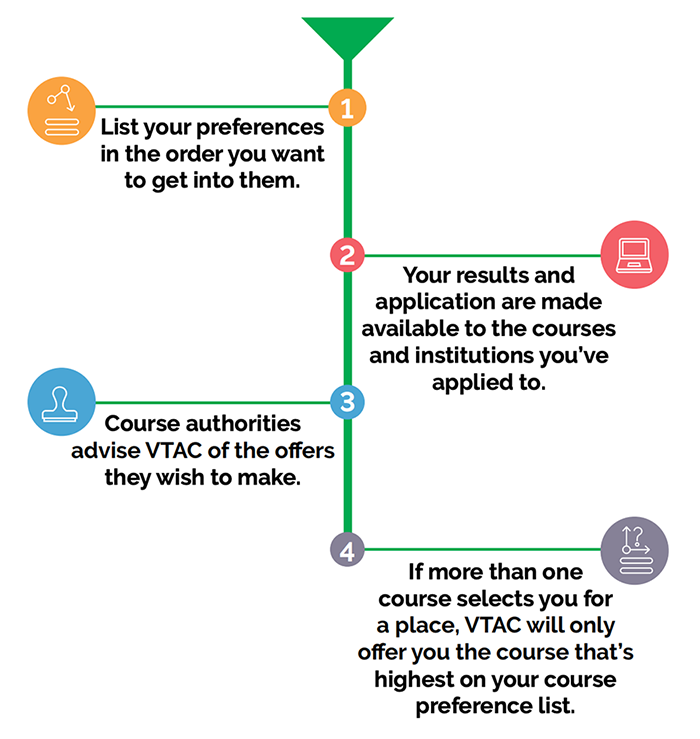
- List your preferences in the order you want to get into them.
- Your results and application are made available to the courses and institutions you’ve applied to.
- Course authorities advise VTAC of the offers they wish to make.
- If more than one course selects you for a place, VTAC will only offer you the course that’s highest on your course preference list.
Example preference list
When you list your course preferences:
- Only list courses you meet the essential requirements and admission criteria for,
- Only list courses you would be happy to study,
- Always list the course you most want to do at the top, and
- Also include some 'pathway courses' in your list.
| List your courses in the order you want to get into them. For example: | ||
|---|---|---|
| Preference 1 | 1234567881 | My dream course |
| Preference 2 | 1234567781 | My second best course |
| Preference 3 | 1234567681 | A ‘pathway course' with similar subjects to my dream course, which could give me credit if I transfer into my dream course at a later date (although I would be happy to complete it if that doesn't happen). |
| Preference 4 | 1234567891 | Another ‘pathway course' like preference 3 but with fewer opportunities to gain credit. |
| Preference 5 | 1234567651 | A course in a similar field to my first and second preference, but without credit options. |
| Preference 6 | 1234567641 | A course in a similar field to my first and second preference, but without credit options and traditionally less competitive than my higher preferences. |
| Preference 7 | 1234567541 | A course in a similar field to my first and second preference, but without credit options and traditionally less competitive than my higher preferences. |
| Preference 8 | 1234567341 | A broad course which provides me with a good foundation through which to apply for further study later on. |
The following scenarios could occur, with the preference list above:
Scenario 1: You receive an offer for your ideal course. Congratulations!
Scenario 2: You receive an offer for your second best course, and are still automatically eligible for a higher offer (your ideal course) if there are vacancies in later rounds.
Scenario 3: You receive an offer for a ‘pathway course'. You will still be eligible for an offer for your ideal course if there are vacancies in later rounds.
Explainer: How to list your course preferences
How should you list your course preferences? You should list courses in the order you want to get into them.
Press play to find advice on why this is important.
Transcript of the video: How to list your Course Preferences
You should list your preferences in the order that you want to get in them, or in the order of your preference.
This means placing your dream course on top… regardless of how likely you think they are going to make you an offer.
Then list other courses that interest you.
… then at the bottom add your back up options and pathways.
Why is this important?
So if you are offered preference #3…
… that means #1 and #2 did not make you an offer.
You won’t find out about lower preferences… as those places would have gone to other applicants.
Do not list courses in the order you’ll get into them.
Here’s why…
Let’s say commerce (Marketing) at ACU is your dream course
But you think you have a better chance of getting in a Bachelor of Communication (Advertising) at Deakin University, so that you put that as #1…
If you meet the requirements of both courses…
You will only receive an offer for your first preference… and not your dream course...
But if you have listed courses in the order of preference, you would have received an offer for your dream course, Commerce (Marketing) at ACU.
There is no room for error if you list courses in order of your preference.
You can change your preference list at any time during open “change of preference” periods. These occur before and in between offer rounds. Refer to the VTAC dates page for deadlines.
To view more information about the VTAC application process visit www.vtac.edu.au
Course application FAQs
What if I can't decide between two courses?
If you can't decide between two courses then look deeper, visit the campus and talk to students. Check out the elective subjects offered by each of the courses.
What if my ATAR isn't high enough?
Still list your ideal courses. Remember, the lowest selection rank from last year may not be the same this year. Also, most courses consider a range of factors in addition to the ATAR. These factors can include subject or SEAS adjustments.
What if I change my mind?
If you change your mind, change your preferences. Change of preference is open from August until December and, for emergencies, in between offer rounds until the end of February.
Will institutions ignore my application if I don't put them first?
Preference listings are only used by VTAC to determine which course you want the most. Course authorities don't make selection decisions based on where you've listed the course on your preference list. They want applicants who have listed them, will succeed, and want to do their courses.
Why can't I receive an offer from all my preferences?
You will only receive an offer for the highest course that wants to make you an offer. You won't find out about any lower preferences, because those places will have already been offered to someone else. This is why it is important to list your preferences in the order you most want to do the courses.
Download
Applying for Equity schemes (SEAS) and scholarships
What is SEAS?
The Special Entry Access Scheme (SEAS) is designed to make sure institutions get a sense of your full potential if you have experienced difficulty during your education. It enables institutions to consider these circumstances and their impact when ranking eligible applicants for a course before making offers. SEAS also addresses the under-representation of certain demographics in some courses.
What SEAS is not
SEAS does not change your educational results or qualifications. And if you are granted special consideration it does not guarantee you an offer. If you apply for SEAS, you still need to meet the ‘essential requirements' and ‘admission criteria' for a course, including prerequisite studies.
Equity schemes (SEAS) and scholarships categories
There are four categories in equity schemes (SEAS) and scholarships. You can apply for all the categories that are relevant to your situation, so long as you apply to each category for a different reason.
- Personal information and location
- Disadvantaged financial background
- Disability or medical condition
- Difficult circumstances

How to apply for equity schemes (SEAS) and scholarships
You can apply for equity schemes (SEAS) and scholarships through your VTAC account, after you have lodged a course application. Applications open on 3 August 2026 and close 5pm 9 October 2026.
Follow these step-by-step instructions to apply.
Providing evidence
Most categories require you to provide evidence, and if you don't supply it your application will not be considered. Quality, not quantity, is the key to providing good and useful evidence. Evidence required may include:
- a written statement that you complete,
- a statement of support from a ‘responsible person' who has specific knowledge of your circumstances, and/or
- financial documentation.
Find out what evidence you need to supply and start preparing it well before the deadline.
Other special consideration schemes
Not all institutions use SEAS, and different institutions recognise different categories. Also, some institutions offer special consideration outside of SEAS. Find out which institutions participate in SEAS and which offer other special consideration programs.
Applying for scholarships
Scholarships help with the cost of study and are awarded for many different reasons, which include community involvement, academic achievement and where you live.
While the value of each scholarship varies, they can help you pay for books, study materials, moving expenses, course fees or other costs associated with tertiary study.
There are lots of scholarships you can apply for through VTAC. Others require you to apply to tertiary institutions or the organisation sponsoring them. It's worth spending an afternoon online, searching for scholarship opportunities. For example, a local community group might offer one that's ideal for you.
Scholarships through VTAC
The scholarships VTAC takes applications for are generally awarded through three categories:
Access and equity scholarships are most often awarded by institutions to support equitable access to tertiary education. Criteria include financial disadvantage, relocating from regional and rural areas or being part of an access equity group.
Merit scholarships are awarded for academic achievement.
Indigenous Commonwealth scholarships are awarded to Aboriginal or Torres Strait Islander applicants across a variety of categories.
What are my chances?
First, you need to apply for most scholarships to be eligible. Then it depends on how many scholarships in a category are available, your eligibility and how you are assessed compared to other eligible applicants. For example, some scholarships are based on an income assessment – if you meet the criteria, you will get a scholarship. For other scholarships, chances vary more widely. Some scholarships are based on academic performance, but many of the scholarships through VTAC are based on equity and access, leadership abilities and community experience — so it's still worth applying if you're not a 'straight A' student.
How to apply for scholarships
You apply for access and equity scholarships as part of the equity schemes (SEAS) and scholarships application. It's simply a matter of following the prompts and entering any relevant details. Most questions require concise written responses. These have strict character limits so it can be a good idea to write a draft first.
Follow these step-by-step instructions to apply.
Providing evidence
Most scholarships require you to provide evidence, and if you don't supply it your application will not be considered. Quality, not quantity, is the key to providing good and useful evidence.
Evidence required may include:
- A written statement that you complete,
- A statement of support from a ‘responsible person' who has specific knowledge of your circumstances, and/or
- Financial documentation.
Find out what evidence you need to supply and start preparing it well before the deadline.
An equity schemes (SEAS) application is (almost) the same as the scholarship application
Which is why every person that wants to submitting an equity schemes (SEAS) application should complete the scholarship section of the application. You can even use the same supporting evidence.
Download
Receive your results and ATAR
You will be able to access your VCE results and ATAR online from 7.00 am on 10 December 2026.
How do I access my results online?
You can access your results via the VCE Results and ATAR Service website or the Results and ATAR app. The app is available from Google Play or the App Store.
You will need your VCAA student number and personal details to register. You will select a secure password when registering, which you will use to access your results on Thursday 10 December 2026.

Register early
You will need to register prior to results being released. Registration opens in August and we encourage you to complete registration by 5pm Wednesday 9 December to ensure the fastest access to your VCE Results and ATAR when they are released.
You only need to register once. The password you create can then be used for both the internet service and mobile app.
Please note: your VTAC account is separate to your registration for the VCE Results and ATAR Service.
Can I speak to someone about my results?
Absolutely. VTAC and VCAA run a joint Post-Results and ATAR Service (PRAS) every year. The service runs for several days after results are released.
You can contact the service by:
- Visiting pras.resultsandatar.vic.edu.au
- Phoning (03) 9637 3877 or the toll-free number 1800 653 080
- Emailing
This email address is being protected from spambots. You need JavaScript enabled to view it.
Understanding the ATAR
The ATAR stands for Australian Tertiary Admission Rank. It is important to note that the ATAR is a rank and not a score. It is represented as a number between 0 and 99.95 in intervals of 0.05 and 99.95 being the highest rank.
Because the ATAR is a rank, there is no pass or fail ATAR. Everyone who receives an ATAR has successfully passed the VCE. The ATAR simply demonstrates each student's achievement in relation to all other students in the year 12 age group. Someone receiving an ATAR of 55, for example, has performed better than 55 per cent of the Year 12 age group that year.
How is the ATAR used?
It is a tool used for tertiary selection, a way for institutions to distinguish between applicants where there are more people applying than there are places in the course.
Once the ATAR has been used for its purpose, entrance into your chosen course, it becomes irrelevant. No one's going to ask for you ATAR once you're already studying, and future employers will be far more interested in your skills and experience than any of your high school results.
Why do you scale subjects?
Subjects aren't scaled because of how ‘hard' or how ‘easy' we think they are. In reality, every subject is scaled in the same way: based on the strength of the competition in a particular year.
VCE Study Scores are standardised rankings, or relative positions, reported on a scale between 0 and 50, with a middle ranking of 30. So, a student with a Study Score of 30 has performed better than half the students in that subject for that year. Scaling is applied to determine the difficulty in achieving the middle ranking - the median study score of 30 – in each subject. The issue here is VCE Study Scores are not standardised against other VCE subjects, they only measure the achievement relative to other students in the same subject.
The competition to achieve the median study score varies between individual studies – in some subjects it is harder to get a 30 because of the cohort of students undertaking it – not because of any inherent difficulty of the subject. So to be fair to all students, no matter what subjects they choose, we scale all subjects against each other to produce a result as though all Year 12 students had taken the same subjects.
I was hoping for a higher ATAR
Remember, the ATAR is only a tool used for tertiary selection, it does not define you as a person, nor does it determine your capabilities.
If your ATAR isn't high enough to get you into your dream course, it's worthwhile contacting the institution to discuss alternative pathways. More often than not, there will be another pathway into the course you want to study. You do have options.
Change of preference will remain open for a time after the results release, so you will have time to make calls, do your research and add in any ‘pathway courses' in time for offers.
Learn more about the ATAR
For detailed information on the ATAR and scaling, see our ATAR page
Change of preference
If you change your mind about the course you want to study you can change your course preferences.
What is change of preference?
During specified periods you can add, remove or re-order the course preferences in your VTAC course application.
You may want to change your preferences if you have changed your mind about which course you most want to study, if a new course has become available and you would like to add it to your preference list, or if a course you had applied for has been cancelled and you want to replace it on your preferences list.
There is no cost involved in changing your preferences. As long as you have paid your course application processing fee, you can change your preferences as many times as you like within the specified periods.

When can I change my preference?
Straight away
Once you've applied, you can keep doing this as many times as you like, free of charge, until the closing date.
After your ATAR is released
After you get your ATAR, you will have a short amount of time to change your preferences.
Finalise your preferences at this point to maximise your chance of receiving the offer you want.
After offers come out
You can also change your preferences between offer rounds, but some courses may already have filled all their places.
All change of preference dates are listed under important dates.
How to change your course preferences
To change your course preferences, log in to your VTAC account and follow the prompts. You can add, delete or re-order your preferences using the up and down arrows.
Some courses do not accept new course applications after a certain date, so check the course description and selection criteria carefully for any new courses you want to add.
You will also need to make sure you meet the requirements for any new courses you add. If you have missed a selection requirement deadline contact the institution to see if you can still apply.
For step-by-step instructions see changing your course preferences.
Offers, enrolment and fees
Offers
When are offers released?
December and January rounds
There are many offer rounds, but most year 12 offers are made in the December and January rounds.
December offers will be released on 23 December 2026, and the January round of offers will be released on 12 January 2027.
Subsequent rounds
After the January Round, there are multiple subsequent rounds. Course authorities can only make offers in future rounds if there are places available—some courses may have filled their quotas after the January round. Your chances of receiving an offer in each round will vary for each course. Typically, there are fewer offers made in each subsequent round.
Supplementary offers
Some institutions make supplementary offers after February Round 1 if they have places available. A supplementary offer is for a course that you have not listed on your course preferences.
You may receive supplementary offers if you have:
- not received an offer listed on your course preferences, and
- given VTAC permission to release your application to all courses with vacancies.
You give this permission either at the time of applying, or you can do this later in your VTAC account. Supplementary offers will be processed weekly after February Round 1.
For all dates for all offer rounds, see VTAC's important dates.
Early offers
Some institutions run early offer programs. Official offers are made through VTAC. Always list your courses in the order of your preference, regardless of what early offer applications you have submitted.
How are offers released?
Offer notifications are sent by email throughout the morning until the published release time.
Because of the volume of offers going out on that day, VTAC will stagger the email roll out, so don't be concerned if your friend has received an offer early in the morning, and you haven't.
At the published release time, you will be able to log into your VTAC account and view your offer in the ‘Course offers' section.
Your offer email is a notification that an offer has been made. The institution will contact you separately with instructions and deadlines for enrolling—usually within two business days. If you do not receive these instructions, you need to contact the institution and not VTAC.
All offers are provisional. Any offer you receive is subject to you:
- meeting eligibility requirements,
- having provided full and correct information on your VTAC application, and
- attending enrolment at the time and date specified in your offer message.
If you don't meet these requirements, your offer may lapse or be withdrawn.
Hoping for a better offer in a future round?
VTAC recommends that you accept any offer you receive, as that offer will usually lapse before the release of the next round's offers. By accepting your offer, you will at least have that course to fall back on if no further offers are made. Accepting an offer does not prevent you from being considered for higher preferences in later offer rounds.
Have mixed feelings about the course or interested in something else?
You can accept your offer and still be eligible for offers from higher preferences in future rounds. Just make sure that whichever course you're hoping to get an offer from is listed higher on your preference list than what you've already been offered. For example, if you received an offer from your third preference, you'll be eligible for offers from preferences one and two.
If there is a course lower on your preference list or new course you are interested in, you can make use of change of preference between the offer rounds. If you move the course you received an offer for down your list, you will be considered for anything above that course in future offer rounds. Then, should you receive a better offer, you can accept that and withdraw from the previous course.
No longer interested in the course you've been offered?
Accepting an offer for a course is your choice. If you have absolutely no desire to enrol in that course, then simply ignore the offer. The offer will lapse and the place will go to somebody else. Just be sure about any decision to not accept a course offer—offers cannot be accepted once they have lapsed.
Didn't get an offer?
If you didn't receive an offer by the January round, you might still receive an offer in February Round 1. However, it's important to know most offers are made in the December and January rounds. So while you might wait in hope for a later round offer it's also a good idea to do some strategic research.
You can change your preferences between rounds so contact institutions for assistance identifying pathway courses or other courses you might want to add to your preference list before change of preference closes.
Also make sure you give permission for institutions to give you supplementary offers.
Enrolling and deferring
Accept an offer by enrolling
To accept an offer you must enrol in the course.
Enrolment procedures will be outlined in the offer email sent by the institution. These instructions differ across each institution, in some cases you may be required to attend in person at a specific date and time, others might require you to enrol online.
Enrolment deadlines are generally within a short period from when the offer is made. If you are unable to complete the enrolment procedure during this period, you should check with the institution about what other arrangements are available. Don't leave this too late, as you may be required to organise documentation and someone to act on your behalf.
Remember, you must enrol by the deadline set by the institution—make sure that you don't miss out.
Thinking of deferring to take a gap year?
Gap years can be a great way to take a break from studying to travel or get work experience. If you're applying for courses with the intention to defer the place, make sure that you check the institutional and course policies on deferment, as not all courses will allow it.
If the institution agrees to defer your place, make sure to get an agreement from them in writing. If you eventually decide not to take up the deferred place, you must inform the institution so that they can offer the place to another applicant.
Course fees
To find out how much your course will cost and how to pay these fees, refer to the tertiary institution that has made you an offer.
HELP to pay your fees
For information about the different types of HELP loans available to students, see financial assistance or the Study Assist website. A HECS-HELP loan (also known as HECS) is available to eligible students that are enrolled in a Commonwealth supported place (CSP). A FEE-HELP loan is available for students are enrolled in a full fee-paying place.
Commonwealth Supported Places
If you have been offered a Commonwealth Supported Place, you must provide your tax file number (TFN) to enrol. For information about getting a TFN, see the Australian Taxation Office website.